In this Cancer Special LiveLifeMore Show, health presenter Dt. Pallavi Jassal talks to Radiation Oncologist Dr. Abhishek Puri, about the causes, symptoms, treatment options of Cancer.
Cancer is a class of diseases characterized by out-of-control cell growth. There are over 100 different types of cancer, and each is classified by the type of cell that is initially affected.
Cancer harms the body when altered cells divide uncontrollably to form lumps or masses of tissue called tumors (except in the case of leukemia where cancer prohibits normal blood function by abnormal cell division in the blood stream). Tumors can grow and interfere with the digestive, nervous, and circulatory systems, and they can release hormones that alter body function. Tumors that stay in one spot and demonstrate limited growth are generally considered to be benign.
More dangerous, or malignant, tumors form when two things occur:
a cancerous cell manages to move throughout the body using the blood or lymphatic systems, destroying healthy tissue in a process called invasion that cell manages to divide and grow, making new blood vessels to feed itself in a process called angiogenesis.
When a tumor successfully spreads to other parts of the body and grows, invading and destroying other healthy tissues, it is said to have metastasized. This process itself is called metastasis, and the result is a serious condition that is very difficult to treat.
Learn More & Live Life More….click on the link to listen to the show…
Cancer is a leading cause of death around the world, according to WHO, which estimates that 84 million people will die of cancer between 2005 and 2015 without intervention.
Oncology is a branch of medicine that deals with the prevention, diagnosis and treatment of cancer. A medical professional who practices oncology is an oncologist.
The 3 components which has improved survival in cancer are
1). Prevention – This is by reduction of risk factors like tobacco & alcohol consumption
2). Early Diagnosis – Screening of common cancers and comprehensive diagnosis and staging
3). Treatment – Multimodality management by discussion in tumour board and treatment in a comprehensive cancer centre
Cancers are best managed by discussing in multi-disciplinary tumour boards where medical oncologist, surgical oncology, radiation oncology, pathologist, radiologist and organ specific oncologists meet to find the best possible management for an individual patient considering the physical, social, psychological, emotional and financial status of the patients.
In this show Health Presenter, Dt. Pallavi Jassal discusses various aspects of CANCER, their Prevention, Symptoms, Causes and Treatment Options with a team of Medical Oncologists Dr. Peush Bajpai & Dr. Rajat Saha from Max Superspeciality Hospital, Shalimar Bagh, New Delhi.

If you suffer from back pain, you may adopt an unnatural posture to try to limit movements that you fear will create potential pain. However, unless there is a fracture or other serious problem, try not to take on an unnatural or stiff posture.
Talk to a Spine Specialist instead.
See When Back Pain is a Spine Compression Fracture or a major spine problem for the spine surgeon’s valuable opinion…
Be on the lookout for any of the following possible warning signs of poor posture:
-Back pain that is worse at certain times of the day or week
-Pain that starts in the neck and moves downwards into the upper back, lower back and extremities
-Pain that goes away after switching positions while sitting or standing
-Sudden back pain that is experienced with a new job, a new office chair, or a new car
-Back pain that comes and goes for months
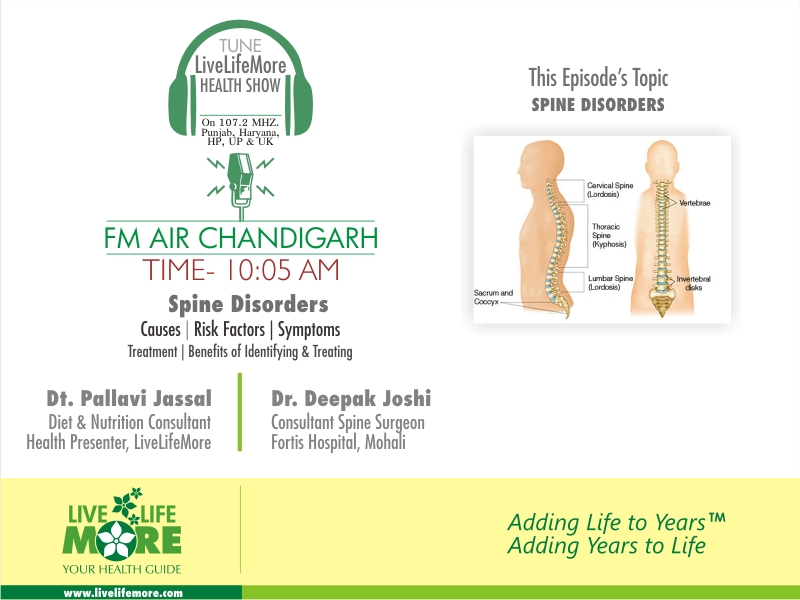
If any of these warning signs apply to you, take a moment to learn more about SPINE DISORDERS in this LiveLifeMore Health Show with Dietitian Pallavi Jassal talking to Dr. Deepak Joshi, Senior Spine Surgeon from Fortis Hospital, Mohali.
Polycystic Ovary Syndrome (PCOS) is a common endocrine disorder among women of reproductive age. Women with PCOS may have enlarged ovaries that contain small collections of fluid — called follicles — located in each ovary as seen during an ultrasound exam.
Infrequent or prolonged menstrual periods, excess hair growth, acne, and obesity can all occur in women with polycystic ovary syndrome. In adolescents, infrequent or absent menstruation may raise suspicion for the condition.
The exact cause of polycystic ovary syndrome is unknown. Early diagnosis and treatment along with weight loss may reduce the risk of long-term complications, such as type 2 diabetes and heart disease.
Learn this and much more in this episode of LiveLifeMore Health Show with Dt. Pallavi Jassal talking to Dr. Sachin Mittal, Senior Endocrinologist with specialization in Diabetes, Thyroid, PCOS & Growth Disorders.
Live Life More Diet & Wellness Clinic offers Diet & Lifestyle Plans for Polycystic Ovary Disease
In today’s LiveLifeMore Health Show, we talk about ALLERGIES…
Here’s the synopsis…
An allergy is a hypersensitivity disorder of the immune system. It’s symptoms include red eyes, itchiness, and runny nose, eczema, hives, or an asthma attack. Allergies can play a major role in conditions such as asthma. Moreover, in some people, severe allergies to environmental or dietary allergens or to medication may result in life-threatening reactions called anaphylaxis.
Allergic reactions occur when a person’s immune system reacts to normally harmless substances in the environment. A substance that causes a reaction is called an allergen.
A variety of tests exist to diagnose allergic conditions. If done they should be ordered and interpreted in light of a person’s history of exposure as many positive test results do not mean a clinically significant allergy. Tests include placing possible allergens on the skin and looking for a reaction such as swelling and blood tests to look for an allergen-specific IgE.
Treatments for allergies include avoiding known allergens, steroids that modify the immune system in general, and medications such as antihistamines and decongestants which reduce symptoms. Many of these medications are taken by mouth, although epinephrine, which is used to treat anaphylactic reactions, is injected. Immunotherapy uses injected allergens to desensitize the body’s response.