
How does soda negatively affect your body?
How does soda negatively affect your body? … Learn this and much more from this video slideshow.

How does soda negatively affect your body? … Learn this and much more from this video slideshow.


You are a busy mom or a working professional or just lazy to do something to loose weight and still keen to be in shape..and have many excuses like…
I understand you want to, but can’t follow diets so I am going to help you with some easy to follow simple things which will help you to shed those extra kilos.
Tips to lose weight naturally ….

Pomegranates help your body in many ways. Find out 9 best benefits of pomegranates for your healthy lifestyle.
 New research suggests 60 to 75 minutes of daily moderate-intensity physical activity is needed to combat the dangers of sitting 8 hours a day.
It has been long suspected that sitting a lot, at work or at home, is not healthy. Previous studies have found that prolonged sitting can raise the chances of heart disease, various cancers and an earlier death.
Think a quick walk around the block is enough to ward off the health risks of sitting at a desk all day? Think again. New research shows the longer you spend sitting, the longer you have to be physically active to avoid a higher mortality risk.
Adults need arou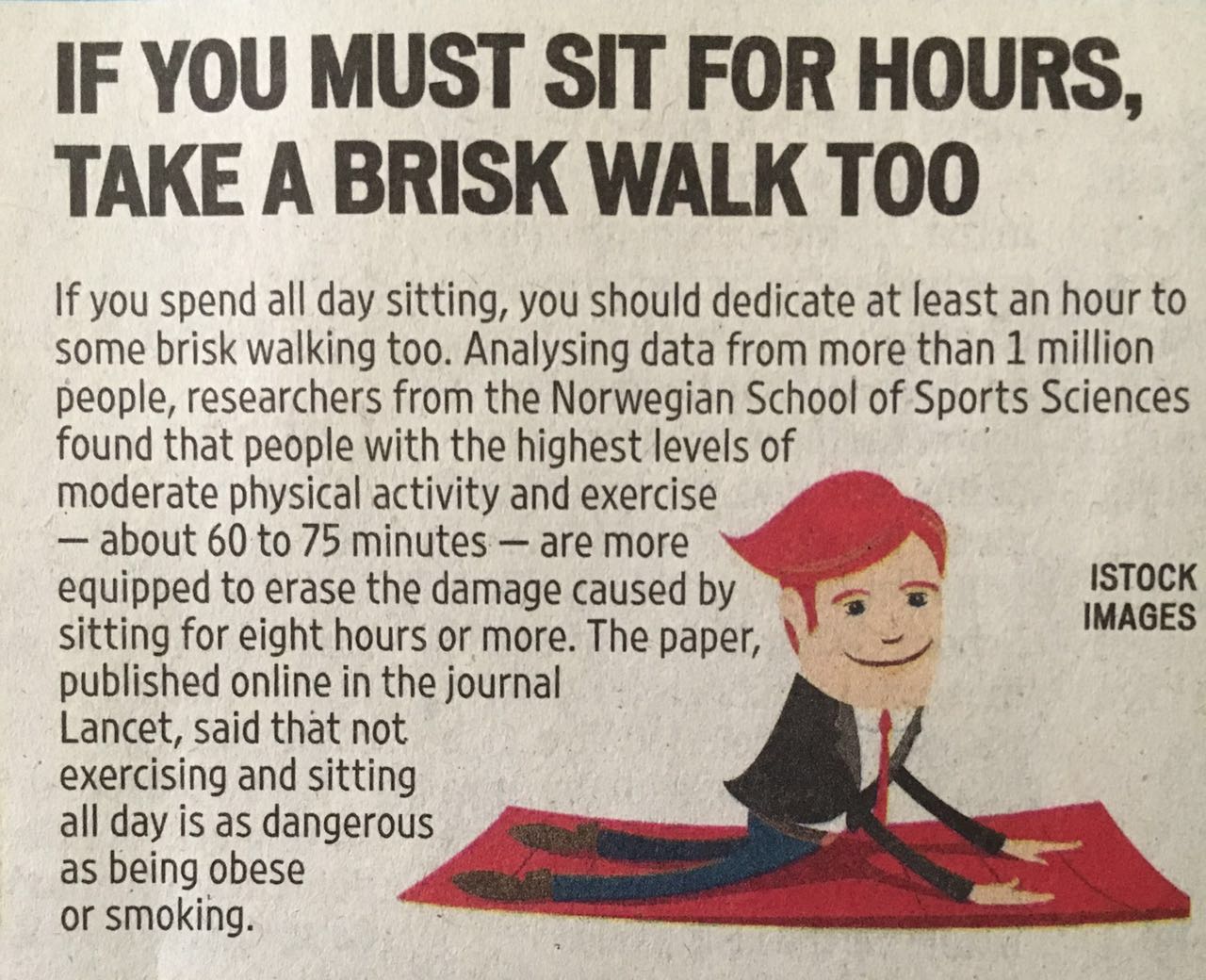 nd 60 to 75 minutes of daily moderate-intensity physical activity — such as a brisk walking or cycling — to fully eliminate the increased risk of death associated with sitting for 8 hours a day, according to research published this month in the medical journal “The Lancet”.
The paper is based on standardized data from the 2009 Canada Fitness Survey and 15 other international studies involving more than one million people around the world, with a followup period ranging from two to 18 years.
Not surprisingly, researchers found a clear association between a higher risk of dying and increased sitting time coupled with lower levels of activity. (Earlier research has linked too much sitting with an increased risk of death from cardiovascular disease, cancer, and it’s also a potential risk factor for many chronic conditions.)
When compared to a particularly fitness-conscious referent group — highly active people who sit less than four hours a day — mortality rates during the followup period were 12 to 59 per cent higher for less-active groups. Among the most-active group, there was no significant connection between time spent sitting and mortality rates, the research notes.
“It’s a positive message,” says lead author Ulf Ekelund, from the Norwegian School of Sports Sciences and the University of Cambridge. “You can actually offset the risk of long sitting hours by being physically active, but you need to do a lot of physical activity — at least an hour per day.”
That’s a much higher amount than the current Canadian physical activity guidelines, which recommend 150 minutes per week of moderate to vigorous-intensity aerobic physical activity for adults aged 18 to 64.
Statistics Canada data shows only 15 per cent of Canadian adults meet these guidelines and, on average, adults spend 9.5 hours a day being sedentary.
With those dire numbers in mind, several Canadian physical activity experts raised red flags about the new paper’s high activity level recommendation.
“If you tell someone you need to exercise 60 minutes a day to decrease your mortality, and they can’t do it, it sets them up for failure,” says Catherine Sabiston, an associate professor in the University of Toronto’s Faculty of Kinesiology and Physical Education and Canada Research Chair in Physical Activity and Mental Health. “That loss of confidence leads to not even trying.”
Dr. Mark Tremblay, director of Healthy Active Living and Obesity Research at the Children’s Hospital of Eastern Ontario Research Institute, praised the new research for looking at such a large population size, but raised concerns about its potential public health message — that you can “sit all you want, as long as you get your exercise.”
“More sitting is associated with increased risk of death — no matter how active you are,” stresses Tremblay.
Tremblay is also chair of the Canadian Society for Exercise Physiology’s guidelines research and development committee, the organization behind the Canadian physical activity guidelines.
The guidelines for adults will be revised within the new couple of years, he says, to reflect a more holistic approach to physical activity — that the “whole day matters,” including time spent sitting, sleeping, walking, and working out.
It’s a change already seen in the guidelines for youth between the ages of 5 to 17, which recommend at least an hour of moderate to vigorous physical activity each day, several hours of light physical activities, a solid night’s sleep and no more than two hours of recreational screen time a day.
When it comes to physical activity, “everything counts,” says Ekelund. “If you’re inactive, doing just a little physical activity is important. The more the better.”
And according to Tremblay, “the best thing is to move more, and sit less.”
The Lancet paper is part of a four-part series on physical activity, which also focuses on the need for collaboration between schools, sports and recreation departments, and urban planning, transportation and environmental sectors to increase physical activity rates around the world.
There has been little progress made in upping these rates, the research notes, with 23 per cent of the global adult population and 80 per cent of school-going adolescents failing to meet the current World Health Organization recommendation of 150 minutes of moderate-intensity exercise every week.
Estimated economic burden of physical inactivity
Canada: $1.5 million
United States: $37 billion
Brazil: $3 billion
United Kingdom: $3 billion
India: $1 million
Figures in Canadian dollars.
Source: The Lancet, 2013 data

In this episode, Dt. Pallavi Jassal discusses with Dr. Mohinish Chhabra of Fortis Hospital, Mohali….some common questions on Liver Diseases such as Fatty Liver, Hepatitis and Cirrhosis.
Learn more & Live Life More…